Borrow on Margin, then farm the borrowed funds on Blend, Soroswap or Aquarius, and unwind safely.
Leveraged yield means borrowing from Vanna and deploying the loan into a Farm pool, so you earn on more than your own capital. On Stellar you do it in two steps, Margin then Farm, or ask Copilot to plan both.
On Margin → Leverage your Assets, deposit collateral and borrow the token the pool needs, for example XLM or BLUSDC for Blend, or SoUSDC for the Soroswap XLM / SoUSDC pool. See Borrow.
2
Farm it
Open the pool on Farm and supply or add liquidity from the margin account. On Blend, Source shows that borrowed funds are used first. See Blend or LP Pools.
3
Check the account
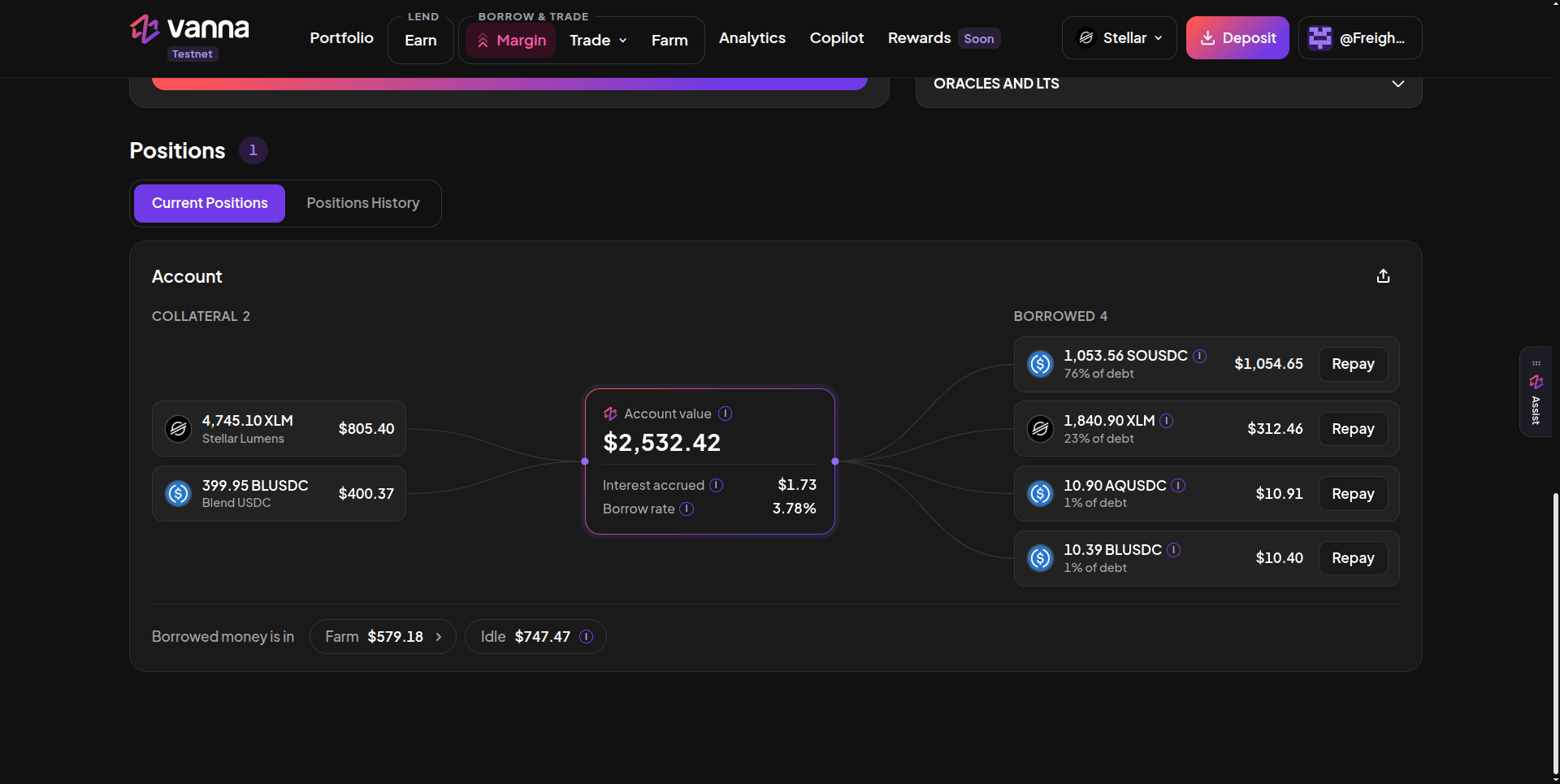
On Margin, Borrowed money is in now shows the amount in Farm. Watch the health factor and the Liquidation buffer.
After farming: the account map shows borrowed money split between Farm and Idle. Click the image to zoom.
Both rates are variable. Compare the pool’s supply APY (Farm) with the asset’s Borrow APY (Earn) and your Net Borrow Rate (Margin) before you start. On testnet, rates can swing a lot.
Borrowing XLM to supply XLM to Blend cancels out XLM price moves on that leg. Borrowing USDC to farm XLM does not: you are now long XLM with leverage, and an XLM drop lowers your health factor.
Each step is its own transaction. If one fails, the earlier ones stay done; check your balances before retrying.
At or below a Health Factor of 1.1, a priced account with debt is a liquidation candidate. The current liquidation path transfers remaining collateral to the liquidator; it does not automatically close the SmartAccount.
{"docsConfig":{"theme":"mint","$schema":"https://mintlify.com/docs.json","name":"Vanna","colors":{"primary":"#7C5CFF","light":"#A387FF","dark":"#5A3ECC"},"logo":{"light":"https://mintcdn.com/vannafinance/UHj8oBBMt2jwIvZH/logo/vanna-light.png?fit=max\u0026auto=format\u0026n=UHj8oBBMt2jwIvZH\u0026q=85\u0026s=b84d79f7687e9ead3384d0c98cfe0ea1","dark":"https://mintcdn.com/vannafinance/UHj8oBBMt2jwIvZH/logo/vanna-dark.png?fit=max\u0026auto=format\u0026n=UHj8oBBMt2jwIvZH\u0026q=85\u0026s=8d4a259c94861810159a811d7d5a66bd","href":"/home"},"favicon":"https://mintcdn.com/vannafinance/UHj8oBBMt2jwIvZH/favicon.png?fit=max\u0026auto=format\u0026n=UHj8oBBMt2jwIvZH\u0026q=85\u0026s=c7a095c28bca61f74a69a54865b8c656","navbar":{"links":[{"href":"https://github.com/vannafinance","label":"GitHub"}],"primary":{"type":"button","label":"Launch App","href":"https://test.vanna.finance"}},"footer":{"socials":{"x":"https://x.com/vannafinance","github":"https://github.com/vannafinance","discord":"https://discord.gg/vanna"}},"search":{"prompt":"Search Vanna docs (Stellar \u0026 Solana)..."},"styling":{"latex":true},"navigation":{"global":{"anchors":[{"anchor":"Discord","icon":"discord","href":"https://discord.gg/vanna"},{"anchor":"X / Twitter","icon":"x-twitter","href":"https://x.com/vannafinance"}]},"pages":[]}},"deployment":{"deploymentMetadataValue":{"subdomain":"vannafinance","hasAudioNarration":false,"actualSubdomain":"vannafinance","customDomains":["docs.vanna.finance"],"gitSource":{"type":"github","owner":"vannafinance","repo":"vanna_docs","deployBranch":"main","contentDirectory":"","isPrivate":false,"mountPath":"","label":""},"chroma":{"collectionId":"15f22fdf-90b4-4222-a4a1-70e1f87febe7","liveDeploymentHistoryId":"6aac2c60d1541a73c58697e1","schemaVersion":"v3","latestBuiltDeploymentHistoryId":"6aac2c60d1541a73c58697e1"},"entitlements":{"AI_CHAT":{"status":"DISABLED"}},"buildId":"6ae2f983ad767fccae346a84","clientVersion":"0.0.4006","searchFilterCounts":[{"language":"default","tag":"Solana","count":75},{"language":"default","tag":"Stellar","count":74},{"language":"default","tag":"User Guide","count":68},{"language":"default","tag":"Developers","count":52},{"language":"default","tag":"Contract Reference","count":28},{"language":"default","tag":"Core Concepts","count":27},{"language":"default","tag":"Margin Account","count":12},{"language":"default","tag":"Farm","count":9},{"language":"default","tag":"Core Mechanics","count":9},{"language":"default","tag":"Solana · Introduction","count":8}]},"assistantConfig":{"enableAskAiButton":false,"enableStarterQuestions":false,"enableContextualStarterQuestions":false,"enableAskAiSearchBar":true},"basePath":"","hasChatPermissions":false,"hasWebMcpPermissions":false,"toggles":[{"name":"kill-isr","enabled":true,"variant":{"name":"disabled","enabled":false,"feature_enabled":true},"impressionData":false},{"name":"agent-mintlify-slack","enabled":true,"variant":{"name":"disabled","enabled":false,"feature_enabled":true},"impressionData":false},{"name":"agent-integrations-settings","enabled":true,"variant":{"name":"disabled","enabled":false,"feature_enabled":true},"impressionData":false},{"name":"automations-pr-grouping","enabled":true,"variant":{"name":"disabled","enabled":false,"feature_enabled":true},"impressionData":false},{"name":"custom-prefix","enabled":true,"variant":{"name":"disabled","enabled":false,"feature_enabled":true},"impressionData":false},{"name":"analytics-v7","enabled":true,"variant":{"name":"disabled","enabled":false,"feature_enabled":true},"impressionData":false},{"name":"user-flows-analytics","enabled":true,"variant":{"name":"disabled","enabled":false,"feature_enabled":true},"impressionData":false},{"name":"no-publish-flow","enabled":true,"variant":{"name":"disabled","enabled":false,"feature_enabled":true},"impressionData":false},{"name":"workos-onboarding","enabled":true,"variant":{"name":"disabled","enabled":false,"feature_enabled":true},"impressionData":false},{"name":"llms-txt-v2","enabled":true,"variant":{"name":"disabled","enabled":false,"feature_enabled":true},"impressionData":false},{"name":"pause-universal-search-reconcile","enabled":true,"variant":{"name":"disabled","enabled":false,"feature_enabled":true},"impressionData":false},{"name":"snapshot-serving-live","enabled":true,"variant":{"name":"disabled","enabled":false,"feature_enabled":true},"impressionData":false},{"name":"stripTemperatureMiddleware","enabled":true,"variant":{"name":"disabled","enabled":false,"feature_enabled":true},"impressionData":false},{"name":"per-site-search-delta","enabled":true,"variant":{"name":"disabled","enabled":false,"feature_enabled":true},"impressionData":false},{"name":"support-platform-pylon-zendesk","enabled":true,"variant":{"name":"disabled","enabled":false,"feature_enabled":true},"impressionData":false},{"name":"snapshot-serving","enabled":true,"variant":{"name":"disabled","enabled":false,"feature_enabled":true},"impressionData":false},{"name":"instant-rollback","enabled":true,"variant":{"name":"disabled","enabled":false,"feature_enabled":true},"impressionData":false},{"name":"granular-notifications-server","enabled":true,"variant":{"name":"disabled","enabled":false,"feature_enabled":true},"impressionData":false},{"name":"granular-notifications","enabled":true,"variant":{"name":"disabled","enabled":false,"feature_enabled":true},"impressionData":false},{"name":"editor-private-page-search","enabled":true,"variant":{"name":"disabled","enabled":false,"feature_enabled":true},"impressionData":false},{"name":"automations-fable","enabled":true,"variant":{"name":"disabled","enabled":false,"feature_enabled":true},"impressionData":false},{"name":"fixed-ai-action-pricing","enabled":true,"variant":{"name":"disabled","enabled":false,"feature_enabled":true},"impressionData":false},{"name":"automation-resolve-merge-conflict","enabled":true,"variant":{"name":"disabled","enabled":false,"feature_enabled":true},"impressionData":false},{"name":"scoped-publishing","enabled":true,"variant":{"name":"disabled","enabled":false,"feature_enabled":true},"impressionData":false},{"name":"mintql","enabled":true,"variant":{"name":"disabled","enabled":false,"feature_enabled":true},"impressionData":false},{"name":"page-level-analytics","enabled":true,"variant":{"name":"disabled","enabled":false,"feature_enabled":true},"impressionData":false},{"name":"editor-version-history-v2","enabled":true,"variant":{"name":"disabled","enabled":false,"feature_enabled":true},"impressionData":false},{"name":"billing-page-v2","enabled":true,"variant":{"name":"disabled","enabled":false,"feature_enabled":true},"impressionData":false},{"name":"workspace-projects","enabled":true,"variant":{"name":"disabled","enabled":false,"feature_enabled":true},"impressionData":false},{"name":"assistant-v5","enabled":true,"variant":{"name":"disabled","enabled":false,"feature_enabled":true},"impressionData":false},{"name":"byok-sep-25","enabled":true,"variant":{"name":"disabled","enabled":false,"feature_enabled":true},"impressionData":false},{"name":"fork-pr-previews","enabled":true,"variant":{"name":"disabled","enabled":false,"feature_enabled":true},"impressionData":false},{"name":"revalidation-jwt","enabled":true,"variant":{"name":"disabled","enabled":false,"feature_enabled":true},"impressionData":false},{"name":"vite-origin","enabled":true,"variant":{"name":"disabled","enabled":false,"feature_enabled":true},"impressionData":false},{"name":"billing-updated-9-15","enabled":true,"variant":{"name":"disabled","enabled":false,"feature_enabled":true},"impressionData":false},{"name":"workos-sso-scim","enabled":true,"variant":{"name":"disabled","enabled":false,"feature_enabled":true},"impressionData":false},{"name":"hobby-abuse-scan","enabled":true,"variant":{"name":"disabled","enabled":false,"feature_enabled":true},"impressionData":false},{"name":"dashboard-inbox","enabled":true,"variant":{"name":"disabled","enabled":false,"feature_enabled":true},"impressionData":false},{"name":"workos-signup","enabled":true,"variant":{"name":"disabled","enabled":false,"feature_enabled":true},"impressionData":false},{"name":"workos-enabled","enabled":true,"variant":{"name":"disabled","enabled":false,"feature_enabled":true},"impressionData":false}],"googleFontsInlined":false},"customCss":[{"filePath":"custom.css","href":"/_mintlify/custom/vannafinance/aa85d521d75cd9c1/custom.css"}],"page":{"pagePath":"stellar/guides/farm/leveraged-yield","slug":"/stellar/guides/farm/leveraged-yield","pageMetadata":{"title":"Leveraged Yield","description":"Borrow on Margin, then farm the borrowed funds on Blend, Soroswap or Aquarius, and unwind safely.","mode":"wide","href":"/stellar/guides/farm/leveraged-yield"},"description":{"compiledSource":"\"use strict\";\nconst {jsx: _jsx} = arguments[0];\nconst {useMDXComponents: _provideComponents} = arguments[0];\nfunction _createMdxContent(props) {\n const _components = {\n p: \"p\",\n ..._provideComponents(),\n ...props.components\n };\n return _jsx(_components.p, {\n children: \"Borrow on Margin, then farm the borrowed funds on Blend, Soroswap or Aquarius, and unwind safely.\"\n });\n}\nfunction MDXContent(props = {}) {\n const {wrapper: MDXLayout} = {\n ..._provideComponents(),\n ...props.components\n };\n return MDXLayout ? _jsx(MDXLayout, {\n ...props,\n children: _jsx(_createMdxContent, {\n ...props\n })\n }) : _createMdxContent(props);\n}\nreturn {\n default: MDXContent\n};\n","frontmatter":{},"scope":{}},"pageType":"default","mdx":{"mdxSource":{"compiledSource":"\"use strict\";const{Fragment:_Fragment,jsx:_jsx,jsxs:_jsxs}=arguments[0];const{useMDXComponents:_provideComponents}=arguments[0];function _createMdxContent(props){const _components={a:`a`,code:`code`,p:`p`,pre:`pre`,span:`span`,strong:`strong`,..._provideComponents(),...props.components},{CodeBlock,Frame,Heading,OptimizedImage,Step,Steps,Warning}=_components;if(!CodeBlock)_missingMdxReference(`CodeBlock`,true);if(!Frame)_missingMdxReference(`Frame`,true);if(!Heading)_missingMdxReference(`Heading`,true);if(!OptimizedImage)_missingMdxReference(`OptimizedImage`,true);if(!Step)_missingMdxReference(`Step`,true);if(!Steps)_missingMdxReference(`Steps`,true);if(!Warning)_missingMdxReference(`Warning`,true);return _jsxs(_Fragment,{children:[_jsxs(_components.p,{children:[`Leveraged yield means borrowing from Vanna and deploying the loan into a Farm pool, so you earn on more than your own capital. On Stellar you do it in two steps, Margin then Farm, or ask `,_jsx(_components.a,{href:`/stellar/guides/copilot`,children:`Copilot`}),` to plan both.`]}),`\n`,_jsx(Heading,{level:`2`,id:`open-a-position`,children:`Open a position`}),`\n`,_jsxs(Steps,{children:[_jsx(Step,{title:`Deposit and borrow`,children:_jsxs(_components.p,{children:[`On `,_jsx(_components.strong,{children:`Margin → Leverage your Assets`}),`, deposit collateral and borrow the token the pool needs, for example XLM or BLUSDC for Blend, or SoUSDC for the Soroswap XLM / SoUSDC pool. See `,_jsx(_components.a,{href:`/stellar/guides/margin/borrow`,children:`Borrow`}),`.`]})}),_jsx(Step,{title:`Farm it`,children:_jsxs(_components.p,{children:[`Open the pool on `,_jsx(_components.strong,{children:`Farm`}),` and supply or add liquidity from the margin account. On Blend, `,_jsx(_components.strong,{children:`Source`}),` shows that borrowed funds are used first. See `,_jsx(_components.a,{href:`/stellar/guides/farm/blend-pools`,children:`Blend`}),` or `,_jsx(_components.a,{href:`/stellar/guides/farm/amm-liquidity`,children:`LP Pools`}),`.`]})}),_jsx(Step,{title:`Check the account`,children:_jsxs(_components.p,{children:[`On Margin, `,_jsx(_components.strong,{children:`Borrowed money is in`}),` now shows the amount in `,_jsx(_components.strong,{children:`Farm`}),`. Watch the health factor and the Liquidation buffer.`]})})]}),`\n`,_jsx(Frame,{caption:`After farming: the account map shows borrowed money split between Farm and Idle. Click the image to zoom.`,children:_jsx(OptimizedImage,{src:`https://mintcdn.com/vannafinance/nTvFas2wipJFpeKy/images/stellar/margin/margin-positions.png?fit=max\u0026auto=format\u0026n=nTvFas2wipJFpeKy\u0026q=85\u0026s=189cdb77f05d2ffd0a548d683eb6c215`,alt:`Margin Current Positions account map with collateral, account value, four borrowed assets each with Repay, and a footer showing Borrowed money is in Farm $579.18 and Idle $747.47`,loading:`lazy`,decoding:`async`,\"data-og-width\":`1920`,width:`1920`,\"data-og-height\":`965`,height:`965`,\"data-path\":`images/stellar/margin/margin-positions.png`,\"data-optimize\":`true`,\"data-opv\":`3`,srcset:`https://mintcdn.com/vannafinance/nTvFas2wipJFpeKy/images/stellar/margin/margin-positions.png?w=280\u0026fit=max\u0026auto=format\u0026n=nTvFas2wipJFpeKy\u0026q=85\u0026s=5888d827bb1626ab84e4bb2cb423ec93 280w, https://mintcdn.com/vannafinance/nTvFas2wipJFpeKy/images/stellar/margin/margin-positions.png?w=560\u0026fit=max\u0026auto=format\u0026n=nTvFas2wipJFpeKy\u0026q=85\u0026s=b58fcea5347e3237b51f001705ed143d 560w, https://mintcdn.com/vannafinance/nTvFas2wipJFpeKy/images/stellar/margin/margin-positions.png?w=840\u0026fit=max\u0026auto=format\u0026n=nTvFas2wipJFpeKy\u0026q=85\u0026s=0b392d0a291af413362aee273c4951c9 840w, https://mintcdn.com/vannafinance/nTvFas2wipJFpeKy/images/stellar/margin/margin-positions.png?w=1100\u0026fit=max\u0026auto=format\u0026n=nTvFas2wipJFpeKy\u0026q=85\u0026s=61ccfac1294fd84bd92c806ac4b1c59f 1100w, https://mintcdn.com/vannafinance/nTvFas2wipJFpeKy/images/stellar/margin/margin-positions.png?w=1650\u0026fit=max\u0026auto=format\u0026n=nTvFas2wipJFpeKy\u0026q=85\u0026s=9782ae5da9cb926f2e01cd689a394708 1650w, https://mintcdn.com/vannafinance/nTvFas2wipJFpeKy/images/stellar/margin/margin-positions.png?w=2500\u0026fit=max\u0026auto=format\u0026n=nTvFas2wipJFpeKy\u0026q=85\u0026s=49ee8f6366f72e964a1170719d553fd7 2500w`})}),`\n`,_jsx(Heading,{level:`2`,id:`does-it-pay`,children:`Does it pay?`}),`\n`,_jsx(_components.p,{children:`Your net yield is roughly:`}),`\n`,_jsx(CodeBlock,{filename:``,numberOfLines:`2`,language:`text`,children:_jsx(_components.pre,{className:`shiki shiki-themes github-light-default dark-plus`,style:{backgroundColor:`#ffffff`,\"--shiki-dark-bg\":`#0B0C0E`,color:`#1f2328`,\"--shiki-dark\":`#D4D4D4`},language:`text`,children:_jsxs(_components.code,{language:`text`,numberOfLines:`2`,children:[_jsx(_components.span,{className:`line`,children:_jsx(_components.span,{children:`farm APY × amount farmed − borrow APY × amount borrowed`})}),`\n`,_jsx(_components.span,{className:`line`,children:_jsx(_components.span,{})})]})})}),`\n`,_jsxs(_components.p,{children:[`Both rates are variable. Compare the pool’s supply APY (Farm) with the asset’s `,_jsx(_components.strong,{children:`Borrow APY`}),` (Earn) and your `,_jsx(_components.strong,{children:`Net Borrow Rate`}),` (Margin) before you start. On testnet, rates can swing a lot.`]}),`\n`,_jsx(Warning,{children:_jsx(_components.p,{children:`Borrowing XLM to supply XLM to Blend cancels out XLM price moves on that leg. Borrowing USDC to farm XLM does not: you are now long XLM with leverage, and an XLM drop lowers your health factor.`})}),`\n`,_jsx(Heading,{level:`2`,id:`unwind`,children:`Unwind`}),`\n`,_jsxs(Steps,{children:[_jsx(Step,{title:`Exit the farm`,children:_jsx(_components.p,{children:`Withdraw from Blend or remove liquidity. Tokens return to the margin account.`})}),_jsx(Step,{title:`Swap if needed`,children:_jsxs(_components.p,{children:[`If you got back a different token than you owe, `,_jsx(_components.a,{href:`/stellar/guides/trade/spot-swap`,children:`swap`}),` for the debt asset.`]})}),_jsx(Step,{title:`Repay`,children:_jsxs(_components.p,{children:[_jsx(_components.a,{href:`/stellar/guides/margin/repay`,children:`Repay`}),` each loan in its own asset.`]})}),_jsx(Step,{title:`Withdraw`,children:_jsxs(_components.p,{children:[_jsx(_components.a,{href:`/stellar/guides/margin/transfer-collateral`,children:`Transfer`}),` what’s left to your wallet.`]})})]}),`\n`,_jsx(_components.p,{children:`Each step is its own transaction. If one fails, the earlier ones stay done; check your balances before retrying.`}),`\n`,_jsx(Warning,{children:`At or below a Health Factor of 1.1, a priced account with debt is a liquidation candidate. The current liquidation path transfers remaining collateral to the liquidator; it does not automatically close the SmartAccount.`}),`\n`,_jsxs(_components.p,{children:[`See `,_jsx(_components.a,{href:`/stellar/guides/sample-strategies`,children:`Sample Strategies`}),` for worked examples.`]})]})}function MDXContent(props={}){const{wrapper:MDXLayout}={..._provideComponents(),...props.components};return MDXLayout?_jsx(MDXLayout,{...props,children:_jsx(_createMdxContent,{...props})}):_createMdxContent(props)}return{default:MDXContent};function _missingMdxReference(id,component){throw new Error(`Expected `+(component?`component`:`object`)+\" `\"+id+\"` to be defined: you likely forgot to import, pass, or provide it.\")}","frontmatter":{},"scope":{"config":{},"pageMetadata":{"title":"Leveraged Yield","description":"Borrow on Margin, then farm the borrowed funds on Blend, Soroswap or Aquarius, and unwind safely.","mode":"wide","href":"/stellar/guides/farm/leveraged-yield"}}},"mdxSourceWithNoJs":null},"mdxExtracts":{"tableOfContents":[{"title":"Open a position","slug":"open-a-position","depth":2,"children":[]},{"title":"Does it pay?","slug":"does-it-pay","depth":2,"children":[]},{"title":"Unwind","slug":"unwind","depth":2,"children":[]}],"codeExamples":{}},"jsLinks":[],"subdomain":"vannafinance","siteName":"Vanna","title":"Leveraged Yield - Vanna","navMaps":{"firstHrefInVersion":{},"firstHrefInLanguage":{}},"lastModified":"2026-10-29T07:45:14.842Z","originalFileLocation":"stellar/guides/farm/leveraged-yield.mdx"},"headHtml":"\u003cscript data-mint-head>(function(){var d=document.documentElement,p=null;if(!p){try{p=localStorage.getItem(\"isDarkMode\")}catch(e){}if(p==='true')p='dark';else if(p==='false')p='light';if(p!=='light'\u0026\u0026p!=='dark'\u0026\u0026p!=='system')p=\"system\"}var r=p==='system'?(matchMedia(\"(prefers-color-scheme: dark)\").matches?'dark':'light'):p;d.classList.remove(r==='dark'?'light':'dark');d.classList.add(r);d.setAttribute(\"data-theme-preference\",p)})();\u003c/script>\u003cmeta data-mint-head name=\"description\" content=\"Borrow on Margin, then farm the borrowed funds on Blend, Soroswap or Aquarius, and unwind safely.\">\u003cmeta data-mint-head name=\"application-name\" content=\"Vanna\">\u003cmeta data-mint-head name=\"generator\" content=\"Mintlify\">\u003clink data-mint-head rel=\"icon\" type=\"image/png\" sizes=\"192x192\" href=\"/mintlify-assets/_mintlify/favicons/vannafinance/r0T44zvAX1A9uSGh/_generated/favicon/android-chrome-192x192.png\" media=\"(prefers-color-scheme: light)\">\u003clink data-mint-head rel=\"apple-touch-icon\" type=\"image/png\" sizes=\"180x180\" href=\"/mintlify-assets/_mintlify/favicons/vannafinance/r0T44zvAX1A9uSGh/_generated/favicon/apple-touch-icon.png\">\u003clink data-mint-head rel=\"icon\" type=\"image/png\" sizes=\"16x16\" href=\"/mintlify-assets/_mintlify/favicons/vannafinance/r0T44zvAX1A9uSGh/_generated/favicon/favicon-16x16.png\" media=\"(prefers-color-scheme: light)\">\u003clink data-mint-head rel=\"icon\" type=\"image/png\" sizes=\"32x32\" href=\"/mintlify-assets/_mintlify/favicons/vannafinance/r0T44zvAX1A9uSGh/_generated/favicon/favicon-32x32.png\" media=\"(prefers-color-scheme: light)\">\u003clink data-mint-head rel=\"shortcut icon\" type=\"image/x-icon\" href=\"/mintlify-assets/_mintlify/favicons/vannafinance/r0T44zvAX1A9uSGh/_generated/favicon/favicon.ico\" media=\"(prefers-color-scheme: light)\">\u003clink data-mint-head rel=\"icon\" type=\"image/png\" sizes=\"192x192\" href=\"/mintlify-assets/_mintlify/favicons/vannafinance/r0T44zvAX1A9uSGh/_generated/favicon-dark/android-chrome-192x192.png\" media=\"(prefers-color-scheme: dark)\">\u003clink data-mint-head rel=\"icon\" type=\"image/png\" sizes=\"16x16\" href=\"/mintlify-assets/_mintlify/favicons/vannafinance/r0T44zvAX1A9uSGh/_generated/favicon-dark/favicon-16x16.png\" media=\"(prefers-color-scheme: dark)\">\u003clink data-mint-head rel=\"icon\" type=\"image/png\" sizes=\"32x32\" href=\"/mintlify-assets/_mintlify/favicons/vannafinance/r0T44zvAX1A9uSGh/_generated/favicon-dark/favicon-32x32.png\" media=\"(prefers-color-scheme: dark)\">\u003clink data-mint-head rel=\"shortcut icon\" type=\"image/x-icon\" href=\"/mintlify-assets/_mintlify/favicons/vannafinance/r0T44zvAX1A9uSGh/_generated/favicon-dark/favicon.ico\" media=\"(prefers-color-scheme: dark)\">\u003cmeta data-mint-head property=\"og:title\" content=\"Leveraged Yield - Vanna\">\u003cmeta data-mint-head property=\"og:description\" content=\"Borrow on Margin, then farm the borrowed funds on Blend, Soroswap or Aquarius, and unwind safely.\">\u003cmeta data-mint-head property=\"og:site_name\" content=\"Vanna\">\u003cmeta data-mint-head property=\"og:url\" content=\"https://docs.vanna.finance/stellar/guides/farm/leveraged-yield\">\u003cmeta data-mint-head property=\"og:type\" content=\"website\">\u003cmeta data-mint-head property=\"og:image\" content=\"https://vannafinance.mintlify.app/_mintlify/api/og/v2?division=Farm\u0026amp;title=Leveraged+Yield\u0026amp;description=Borrow+on+Margin%2C+then+farm+the+borrowed+funds+on+Blend%2C+Soroswap+or+Aquarius%2C+and+unwind+safely.\u0026amp;theme=ce14588e1c9c342033dcc7d2\u0026amp;signature=85465e202e03b65ee6a7b925b51b46833cd782d6215b02d24aad72f4ae82426a\">\u003cmeta data-mint-head property=\"og:image:width\" content=\"1200\">\u003cmeta data-mint-head property=\"og:image:height\" content=\"630\">\u003cmeta data-mint-head name=\"twitter:card\" content=\"summary_large_image\">\u003cmeta data-mint-head name=\"twitter:title\" content=\"Leveraged Yield - Vanna\">\u003cmeta data-mint-head name=\"twitter:description\" content=\"Borrow on Margin, then farm the borrowed funds on Blend, Soroswap or Aquarius, and unwind safely.\">\u003cmeta data-mint-head name=\"twitter:image\" content=\"https://vannafinance.mintlify.app/_mintlify/api/og/v2?division=Farm\u0026amp;title=Leveraged+Yield\u0026amp;description=Borrow+on+Margin%2C+then+farm+the+borrowed+funds+on+Blend%2C+Soroswap+or+Aquarius%2C+and+unwind+safely.\u0026amp;theme=ce14588e1c9c342033dcc7d2\u0026amp;signature=85465e202e03b65ee6a7b925b51b46833cd782d6215b02d24aad72f4ae82426a\">\u003cmeta data-mint-head name=\"twitter:image:width\" content=\"1200\">\u003cmeta data-mint-head name=\"twitter:image:height\" content=\"630\">\u003cmeta data-mint-head name=\"msapplication-config\" content=\"/mintlify-assets/_mintlify/favicons/vannafinance/r0T44zvAX1A9uSGh/_generated/favicon/browserconfig.xml\">\u003cmeta data-mint-head name=\"apple-mobile-web-app-title\" content=\"Vanna\">\u003cmeta data-mint-head name=\"msapplication-TileColor\" content=\"#7C5CFF\">\u003clink data-mint-head rel=\"canonical\" href=\"https://docs.vanna.finance/stellar/guides/farm/leveraged-yield\">\u003clink data-mint-head rel=\"alternate\" type=\"application/xml\" href=\"/sitemap.xml\">\u003clink data-mint-head rel=\"alternate\" type=\"text/markdown\" href=\"/stellar/guides/farm/leveraged-yield.md\">\u003cscript data-mint-head type=\"application/ld+json\">{\"@context\":\"https://schema.org\",\"@graph\":[{\"@type\":\"Organization\",\"@id\":\"https://docs.vanna.finance/#organization\",\"name\":\"Vanna\",\"url\":\"https://docs.vanna.finance\",\"logo\":{\"@type\":\"ImageObject\",\"url\":\"https://mintcdn.com/vannafinance/UHj8oBBMt2jwIvZH/logo/vanna-light.png?fit=max\u0026auto=format\u0026n=UHj8oBBMt2jwIvZH\u0026q=85\u0026s=b84d79f7687e9ead3384d0c98cfe0ea1\"}},{\"@type\":\"WebSite\",\"@id\":\"https://docs.vanna.finance#website\",\"name\":\"Vanna\",\"url\":\"https://docs.vanna.finance\",\"publisher\":{\"@id\":\"https://docs.vanna.finance/#organization\"}},{\"@type\":\"WebPage\",\"@id\":\"https://docs.vanna.finance/stellar/guides/farm/leveraged-yield#webpage\",\"url\":\"https://docs.vanna.finance/stellar/guides/farm/leveraged-yield\",\"name\":\"Leveraged Yield\",\"description\":\"Borrow on Margin, then farm the borrowed funds on Blend, Soroswap or Aquarius, and unwind safely.\",\"dateModified\":\"2026-10-29T07:45:14.842Z\",\"isPartOf\":{\"@id\":\"https://docs.vanna.finance#website\"},\"breadcrumb\":{\"@id\":\"https://docs.vanna.finance/stellar/guides/farm/leveraged-yield#breadcrumb\"}},{\"@type\":\"BreadcrumbList\",\"@id\":\"https://docs.vanna.finance/stellar/guides/farm/leveraged-yield#breadcrumb\",\"itemListElement\":[{\"@type\":\"ListItem\",\"position\":1,\"name\":\"Farm\",\"item\":\"https://docs.vanna.finance/stellar/guides/farm/overview\"},{\"@type\":\"ListItem\",\"position\":2,\"name\":\"Leveraged Yield\",\"item\":\"https://docs.vanna.finance/stellar/guides/farm/leveraged-yield\"}]},{\"@type\":[\"Article\",\"TechArticle\"],\"@id\":\"https://docs.vanna.finance/stellar/guides/farm/leveraged-yield#article\",\"headline\":\"Leveraged Yield\",\"name\":\"Leveraged Yield\",\"description\":\"Borrow on Margin, then farm the borrowed funds on Blend, Soroswap or Aquarius, and unwind safely.\",\"url\":\"https://docs.vanna.finance/stellar/guides/farm/leveraged-yield\",\"mainEntityOfPage\":{\"@id\":\"https://docs.vanna.finance/stellar/guides/farm/leveraged-yield#webpage\"},\"dateModified\":\"2026-10-29T07:45:14.842Z\",\"publisher\":{\"@id\":\"https://docs.vanna.finance/#organization\"},\"isPartOf\":{\"@id\":\"https://docs.vanna.finance#website\"}}]}\u003c/script>\u003cscript data-mint-head type=\"application/ld+json\">{\"@context\":\"https://schema.org\",\"@type\":\"WebSite\",\"name\":\"Vanna\",\"creator\":{\"@type\":\"Organization\",\"name\":\"Mintlify\",\"url\":\"https://mintlify.com\"}}\u003c/script>","siteName":"Vanna","nav":{"global":{"anchors":[{"anchor":"Discord","icon":"discord","href":"https://discord.gg/vanna"},{"anchor":"X / Twitter","icon":"x-twitter","href":"https://x.com/vannafinance"}]},"tabs":[{"tab":"Home","icon":"house","pages":[{"title":"Home","href":"/home"}]},{"tab":"User Guide","icon":"book-open","menu":[{"item":"Stellar","icon":"https://mintlify.s3.us-west-1.amazonaws.com/vannafinance/images/chains/stellar.png","groups":[{"group":"Stellar · Get Started","pages":[{"title":"Vanna on Stellar","sidebarTitle":"Overview","mode":"wide","href":"/stellar/home"},{"title":"Getting Started","mode":"wide","href":"/stellar/guides/getting-started"},{"title":"Connect Your Wallet","mode":"wide","href":"/stellar/guides/connect-wallet"},{"title":"Portfolio","mode":"wide","href":"/stellar/guides/portfolio"},{"title":"Copilot","mode":"wide","href":"/stellar/guides/copilot"}]},{"group":"How Vanna Works","pages":[{"title":"How Vanna Works","mode":"wide","href":"/stellar/guides/how-vanna-works"},{"title":"For Liquidity Providers","mode":"wide","href":"/stellar/guides/for-liquidity-providers"},{"title":"For Traders and Borrowers","mode":"wide","href":"/stellar/guides/for-traders"}]},{"group":"Earn","pages":[{"title":"Earn Overview","mode":"wide","href":"/stellar/guides/earn/overview"},{"title":"Supply to Earn","mode":"wide","href":"/stellar/guides/earn/supply"},{"title":"Withdraw from Earn","mode":"wide","href":"/stellar/guides/earn/withdraw"}]},{"group":"Margin Account","pages":[{"title":"Margin Account","mode":"wide","href":"/stellar/guides/margin/overview"},{"title":"Open a Margin Account","mode":"wide","href":"/stellar/guides/margin/open-account"},{"title":"Deposit Collateral","mode":"wide","href":"/stellar/guides/margin/deposit-collateral"},{"title":"Borrow","mode":"wide","href":"/stellar/guides/margin/borrow"},{"title":"Repay a Loan","mode":"wide","href":"/stellar/guides/margin/repay"},{"title":"Transfer Collateral","mode":"wide","href":"/stellar/guides/margin/transfer-collateral"}]},{"group":"Trade","pages":[{"title":"Spot Swap","mode":"wide","href":"/stellar/guides/trade/spot-swap"}]},{"group":"Farm","pages":[{"title":"Farm Overview","mode":"wide","href":"/stellar/guides/farm/overview"},{"title":"Blend Single-Asset Pools","mode":"wide","href":"/stellar/guides/farm/blend-pools"},{"title":"AMM LP Pools","description":"Add two-sided XLM / USDC liquidity on Soroswap or Aquarius from your margin account and earn trading fees.","mode":"wide","href":"/stellar/guides/farm/amm-liquidity"},{"title":"Leveraged Yield","mode":"wide","href":"/stellar/guides/farm/leveraged-yield"}]},{"group":"Risk Management","pages":[{"title":"Health Factor","description":"The one number that decides whether you can borrow more, withdraw, or get liquidated.","mode":"wide","href":"/stellar/guides/margin/health-factor"},{"title":"Liquidation","mode":"wide","href":"/stellar/guides/margin/liquidation"}]},{"group":"Risk Monitoring Dashboard","pages":[{"title":"Risk Monitoring Dashboard","mode":"wide","href":"/stellar/guides/analytics/overview"},{"title":"Positions","mode":"wide","href":"/stellar/guides/analytics/positions"},{"title":"Liquidation Monitoring","mode":"wide","href":"/stellar/guides/analytics/liquidations"},{"title":"Risk Explorer","mode":"wide","href":"/stellar/guides/analytics/risk-explorer"}]},{"group":"Sample Strategies","pages":[{"title":"Sample Strategies","mode":"wide","href":"/stellar/guides/sample-strategies"},{"title":"Cross-Pool Rate Carry","mode":"wide","href":"/stellar/guides/strategies/cross-pool-rate-carry"},{"title":"Earn, Borrow, and Hedge","mode":"wide","href":"/stellar/guides/strategies/earn-borrow-hedge"},{"title":"Parallel Rate Carry","mode":"wide","href":"/stellar/guides/strategies/parallel-rate-carry"},{"title":"Dual Yield Stack","mode":"wide","href":"/stellar/guides/strategies/dual-yield-stack"}]}]},{"item":"Solana","icon":"https://mintlify.s3.us-west-1.amazonaws.com/vannafinance/images/chains/solana.png","pages":[{"title":"Solana","href":"/solana/home"}]}]},{"tab":"Core Concepts","icon":"graduation-cap","menu":[{"item":"Stellar","icon":"https://mintlify.s3.us-west-1.amazonaws.com/vannafinance/images/chains/stellar.png","pages":[{"title":"Stellar","href":"/stellar/learn/overview"}]},{"item":"Solana","icon":"https://mintlify.s3.us-west-1.amazonaws.com/vannafinance/images/chains/solana.png","pages":[{"title":"Solana","href":"/solana/learn/overview"}]}],"pages":[{"title":"Core Concepts","href":"/stellar/learn/overview"}]},{"tab":"Developers","icon":"code","menu":[{"item":"Stellar","icon":"https://mintlify.s3.us-west-1.amazonaws.com/vannafinance/images/chains/stellar.png","pages":[{"title":"Stellar","href":"/stellar/developers/overview"}]},{"item":"Solana","icon":"https://mintlify.s3.us-west-1.amazonaws.com/vannafinance/images/chains/solana.png","pages":[{"title":"Solana","href":"/solana/developers/overview"}]}],"pages":[{"title":"Developers","href":"/stellar/developers/overview"}]},{"tab":"Resources","icon":"circle-info","menu":[{"item":"Stellar","icon":"https://mintlify.s3.us-west-1.amazonaws.com/vannafinance/images/chains/stellar.png","pages":[{"title":"Stellar","href":"/stellar/resources/faq"}]},{"item":"Solana","icon":"https://mintlify.s3.us-west-1.amazonaws.com/vannafinance/images/chains/solana.png","pages":[{"title":"Solana","href":"/solana/resources/faq"}]}],"pages":[{"title":"Resources","href":"/stellar/resources/faq"}]}]},"title":"Leveraged Yield - Vanna","buildId":"dpl_2xiSHD9XEvLsPGPcfoMtkLTB3dy9","deploymentId":"dpl_2xiSHD9XEvLsPGPcfoMtkLTB3dy9","dynamics":["07c022d89b","a74be98ba7"],"chunks":["Frame-DYplxqhs.js","DynamicMarkdown-Cc6AuSHS.js","zoom-image-lightbox-BNnMwe0F.js","lightbox-handle-r17bVUz3.js"]}